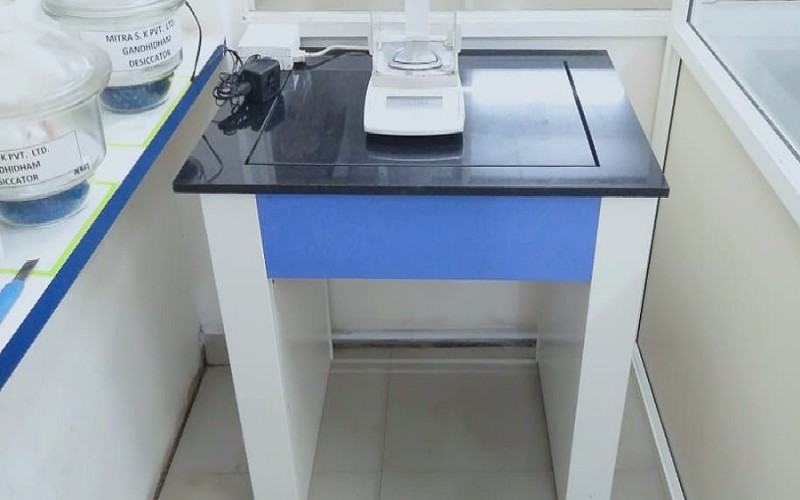
An anti-vibration lab bench or table is a specialized workstation designed to minimize the impact of vibrations on sensitive instruments and experiments. These tables are typically used in laboratories where precision measurements and testing are crucial, such as in analytical, medical, and research settings.
Key Features and Benefits:
Vibration Isolation:
The primary function is to isolate the working surface from external vibrations, preventing interference with measurements and experiments.
Heavy Framework:
Anti-vibration tables often feature a sturdy, heavy framework, sometimes filled with materials like sand, to provide stability and mass.
Damping Materials:
Rubber shock mounts, vibration-damping pads, or other specialized materials are incorporated to absorb and dissipate vibrations.
Granite or Other Smooth Surfaces:
A flat, smooth surface, often made of granite, provides a stable platform for sensitive equipment like analytical balances and microscopes.
Two-Part Construction:
Some designs feature a separate inner section that rests on the damping materials, further isolating the working surface.
Applications:
Anti-vibration tables are used for a wide range of applications, including:
Weighing delicate items with high-precision balances
Performing microscopic analysis, especially in IVF and ICSI procedures
Conducting chemical analysis and density determination
Testing electronic components in quality control
Improved Accuracy:
By reducing vibrations, these tables help ensure more accurate and reliable measurements and experimental results.
Enhanced Stability:
They provide a stable platform for sensitive instruments, minimizing the impact of environmental disturbances.
_1753866055.png)